

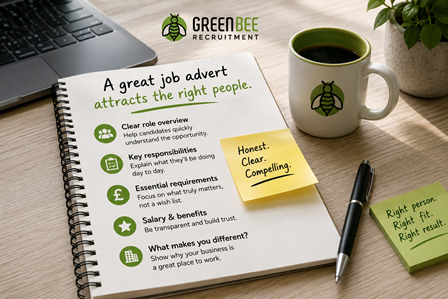
You have a vacancy. You know what experience you need. You have written down the responsibilities, added a few requirements and posted the advert.
Then very little happens.
Perhaps you receive only a handful of applications. Perhaps plenty of people apply, but hardly any of them are suitable. Or perhaps you find yourself looking through the same advert a week later, wondering why the right person has not appeared.
At that point, it is tempting to blame the job board, the candidate market or the familiar idea that nobody wants to work anymore.
Sometimes the problem is much closer to home.
Your job advert may be pushing good people away before they have had the chance to understand the opportunity.
Why do good candidates ignore some job adverts?
Most people do not read every vacancy carefully from beginning to end. They scan.
They want to know what the job is, where it is based, what it pays and whether the opportunity is relevant to them. They also want to get a sense of the business behind the advert.
When those answers are hidden beneath vague wording, internal terminology or a long list of duties, the reader has to work too hard.
Strong candidates often have choices. They may be comparing several opportunities at the same time. If another employer explains the role more clearly, that employer may earn their attention first.
This does not mean every advert needs clever language or an elaborate design. It means candidates need useful information quickly.
Is a job advert the same as a job description?
No, although many businesses still treat them as though they are.
A job description records what an employee is expected to do. It may include reporting structures, internal responsibilities, policies and detailed duties. It is useful once someone is employed and can also help a business define the position.
A job advert has a different purpose.
Its job is to help the right person decide whether they should apply.
That means it needs to communicate both sides of the opportunity. What does the business need? What will the candidate be doing? Why might the role suit them? What will they receive in return?
Copying and pasting a job description into a job board may be quick, but it often produces something that feels administrative rather than inviting.
At Green Bee Recruitment, we structure adverts around three straightforward areas: the Role, the Responsibilities and the Requirements. This helps candidates understand the opportunity without having to navigate pages of internal detail.
What should the opening of a job advert say?
It should tell the reader something useful.
“An exciting opportunity has arisen” may sound positive, but it says almost nothing about the role.
The same applies to opening with a long history of the company. Candidates may care about that information, but first they need to know whether the vacancy itself is relevant.
Consider the difference between these two openings:
“An exciting opportunity has arisen for a motivated individual to join our growing team.”
And:
“You will manage a portfolio of small-business clients while working within a supportive accountancy team that will help you continue developing your technical knowledge.”
The second version gives the reader a clearer picture. It explains what they will do, who they will work with and what they may gain from the role.
It does not exaggerate. It simply answers the question the candidate is already asking:
“What would working here actually be like?”
Should you include the difficult parts of the role?
Yes.
This is where some employers become nervous. They worry that mentioning cold calling, weekend work, targets, travel or challenging responsibilities will reduce applications.
It probably will.
But that is not necessarily a bad result.
A candidate who does not want to make sales calls should understand that before applying for a role built around sales calls. Someone who cannot work weekends needs to know if weekends are essential.
Being transparent may produce fewer applications, but the people who do apply are more likely to understand the reality of the position.
A successful advert is not the one that attracts the highest number of CVs. It is the one that helps the right people make an informed decision.
Are all your requirements genuinely essential?
This is another area worth questioning.
Many job adverts gradually become descriptions of an imaginary perfect candidate. The business wants a particular qualification, several years of direct experience, knowledge of every system, excellent communication skills, leadership ability and a long collection of personal qualities.
But how much of that is truly necessary on the first day?
There is a meaningful difference between something a candidate must already possess and something they could learn with the right support.
When every preference is presented as essential, capable candidates may decide not to apply. This can be particularly damaging when someone has relevant transferable experience but does not match the employer’s exact wording.
Before publishing an advert, ask what would genuinely prevent someone from doing the job.
Keep those requirements clear.
Then consider which skills could be developed after they join.
Why do vague benefits weaken an advert?
Because candidates have seen the same phrases many times.
“Competitive salary.”
“Friendly working environment.”
“Excellent opportunities.”
Those statements are not necessarily untrue, but they do not give the reader much evidence.
What is the salary range?
What makes the working environment supportive?
What development could someone realistically expect?
If you offer flexible working, explain the arrangement. If employees receive structured training, say what that involves. If there is a genuine route for progression, describe what progression has looked like for other people in the business.
Specific information builds more trust than attractive but unsupported language.
Candidates do not expect every employer to offer everything. They do expect an honest account of what is available.
Should the salary be included?
Wherever possible, yes.
Salary is one of the first things many candidates want to understand. That does not make them disloyal, greedy or motivated only by money. It means they need to know whether the opportunity is financially realistic.
Leaving the salary out can create unnecessary applications, conversations and interviews with people whose expectations do not match the available budget.
It can also make an employer appear less transparent than competitors who are willing to publish a range.
If the exact salary depends on experience, explain the range and what influences the final offer.
Clear information allows candidates to qualify themselves before everyone invests more time.
What does a good job advert sound like?
It sounds like the business that is hiring.
A nursery, engineering company, accountancy practice and hospitality business should not all sound identical.
The advert should reflect the environment without slipping into forced humour, corporate clichés or exaggerated promises.
This is where knowing the business matters.
Before Green Bee prepares an advert, we aim to understand the company, its culture, the practical requirements of the position and the kind of person likely to thrive there. The advert is then prepared before the wider candidate search and advertising campaign begin.
That understanding cannot be replaced by copying a template and changing the job title.
Templates can provide structure. They should not remove the personality or truth of the opportunity.
How can you improve your advert today?
Read it as though you know nothing about your business.
Can you quickly find the salary, location and hours?
Does the opening explain what the person will actually do?
Can you tell which requirements are essential?
Does the advert explain what the employee receives, as well as what the employer expects?
Does it sound honest?
Most importantly, would the right candidate finish reading with a clear picture of the role?
A good job advert does not persuade everyone to apply.
It helps the right people recognise that the opportunity may be worth a conversation.