

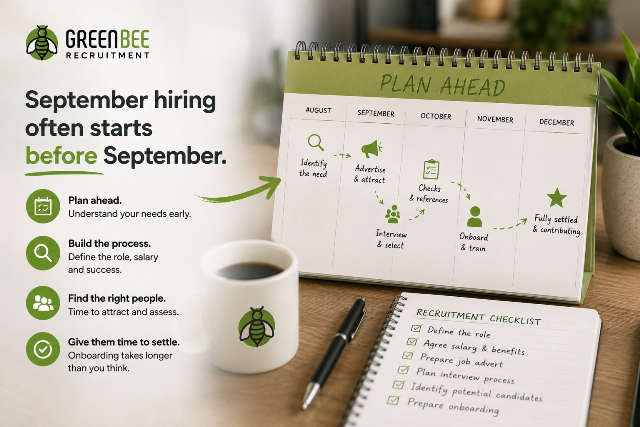
September often feels like a fresh start.
Summer holidays come to an end. Schools return. Diaries become busier, routines settle and businesses begin looking towards the final part of the year.
It is also the point when many employers realise they need more people.
Perhaps a team member has decided not to return after the summer. Perhaps customer demand is increasing. Perhaps a project that felt comfortably distant in June is suddenly due to begin.
The vacancy goes live in September, and the business hopes the new employee will arrive shortly afterwards.
But recruitment does not begin when the advert is published.
It begins when the business first understands that it may need someone.
For many September hires, that should happen before the new term begins.
Why do businesses wait?
Usually because recruitment has to compete with everything else.
There are holidays to manage, customers to serve, projects to deliver and employees to support. If the team is still coping, hiring can feel like something that can wait for another week.
Then another week passes.
By the time the pressure becomes impossible to ignore, the role is no longer part of a plan. It is an emergency.
The manager needs someone immediately, but candidates still need time to see the advert, apply, speak to the employer, attend interviews, consider an offer and work their notice.
Even a smooth process takes time.
Waiting does not remove those stages. It simply compresses the employer’s side of the decision.
What should you ask before September?
Begin with what is likely to change.
Will customer demand increase?
Are any employees expected to leave, reduce their hours or take extended absence?
Is the business planning to open a new location, win more clients or introduce another service?
Which team members are already carrying more than they should?
What work is being delayed because nobody has the capacity to own it?
These are not only recruitment questions. They are business planning questions.
An empty role affects more than a rota. It can affect customer service, growth, morale and the amount of time managers spend away from their most important responsibilities.
That is why hiring should not sit at the bottom of the administrative list.
The decision to recruit should begin with the impact the role will have on the business.
How long will recruitment take?
That depends on the role, the candidate market, the recruitment method and how quickly decisions are made.
A business may find a suitable candidate rapidly, particularly if it already has a strong network or talent pipeline.
However, it is dangerous to plan around the best possible outcome.
A candidate may have a notice period. Interview diaries may be difficult to coordinate. The first advertising campaign may need adjusting. The right person may be interested but unavailable until later in the year.
Planning early creates room for those realities.
It also allows the business to make better decisions.
When a vacancy is urgent, an employer may become tempted to appoint the first person who appears capable. When there is time, the conversation can focus on whether that person is genuinely right for the role, the team and the longer-term needs of the business.
What needs to be decided before you advertise?
More than the job title.
The business needs to understand why the role exists and what success will look like.
What does the person need to achieve?
Which responsibilities are central to the role?
What experience is essential, and what could be taught?
What salary is realistic for the level of person required?
Who will manage the new employee?
What support will they receive during their first few weeks?
What will make a good candidate choose this business over another opportunity?
These questions shape the advert, interview process and eventual offer.
They also reveal whether the business is truly ready to hire.
Green Bee’s discovery and onboarding processes are intended to explore the company, the vacancy, the desired person, salary, hours, qualifications, skills and benefits before the recruitment campaign begins.
That groundwork may feel slower than immediately posting an advert.
In practice, it can prevent confusion and delay later.
Should you advertise before the role is urgent?
You should not advertise a vacancy that does not genuinely exist.
However, you can prepare before the start date becomes critical.
You can review the job advert, benchmark the salary, agree the decision-making process and identify likely advertising channels.
You can also reconnect with relevant people already known to the business.
Preparation means that when the vacancy is approved, the campaign can begin with clarity rather than a rushed collection of copied documents and uncertain expectations.
Green Bee aims to move from understanding the role to preparing and launching the recruitment activity through a structured process. Depending on the service, this can include advert preparation, job board advertising, internal database searches, targeted candidate sourcing and ongoing client updates.
Is salary planning part of recruitment planning?
Absolutely.
A business may know what it paid the last person, but that does not automatically mean the same amount will attract the right candidate now.
The role may have changed. Candidate expectations may have shifted. The available pool of people may be smaller than it was during the previous search.
Discovering that the salary is uncompetitive after several quiet weeks wastes valuable time.
This does not mean every business must offer the highest salary in its sector.
It means the employer should understand how the proposed package compares and be ready to explain the wider opportunity honestly.
Salary matters, but so do working patterns, flexibility, management, progression, culture and the practical experience of joining the organisation.
The complete offer needs to make sense.
What if you expect to hire before Christmas?
Work backwards.
Consider when you want the person to be fully contributing, not merely when you want them to sign a contract.
A new employee may need to complete a notice period before starting. They will then need an induction, introductions, training and time to understand the role.
Someone who starts in late November may not be fully settled before the Christmas period.
If the position is important to your final-quarter plans, recruitment activity may need to begin much earlier than expected.
This is particularly important when relevant checks, references or qualifications are required.
Green Bee’s compliance processes may include right-to-work verification, references, qualification checks, identity documents and DBS checks where relevant to the role. These steps protect the candidate, client and wider organisation, but they also need to be considered within the hiring timeline.
Does early planning guarantee the perfect hire?
No.
Recruitment involves people, and people do not always follow a predictable timetable.
Candidates can change their minds. Business circumstances can shift. A campaign may need to be adjusted.
Early planning does not remove uncertainty.
It gives the business more room to respond to it.
It allows time to improve an advert that is not performing, widen the search or reconsider an unrealistic requirement. It reduces the pressure to compromise simply because the vacancy has become painful.
Most importantly, it moves recruitment from panic to preparation.
What should you do now?
Look at the rest of the year.
Are you expecting growth?
Is anyone carrying a workload that cannot continue indefinitely?
Could a resignation, seasonal increase or new contract leave the team exposed?
Are you hoping to recruit before Christmas?
You do not need to publish a job advert today.
You do need to understand what is coming.
September hiring rarely begins in September.
It begins when a business looks ahead, recognises the gap and decides to act before that gap becomes an emergency.